

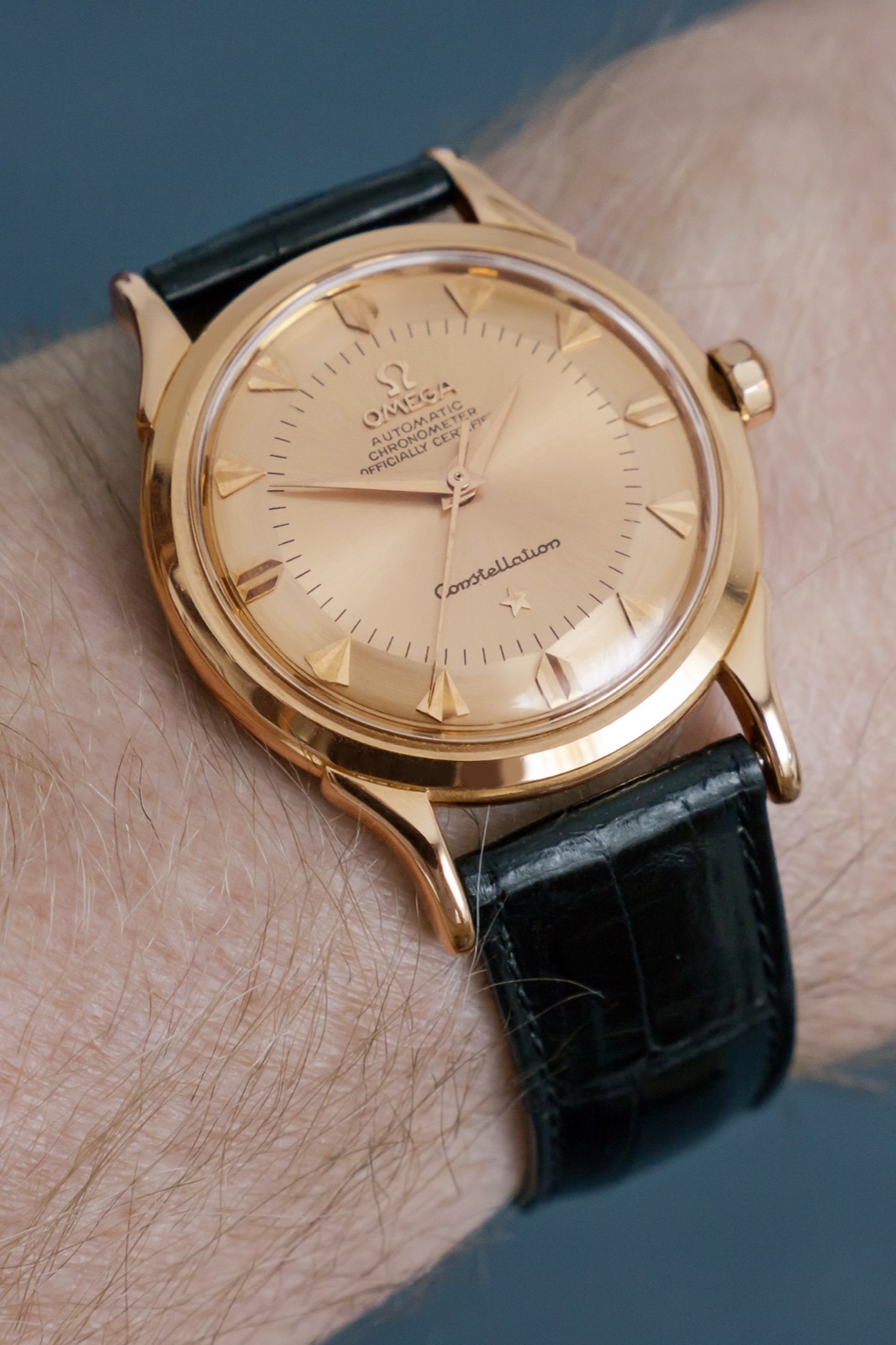
The Omega Constellation | family history
Omega's chronometer line: the family the brand built to prove its precision case-by-case rather than via the Speedmaster's adventure or the Seamaster's depth. Launched in 1952, the Constellation has been Omega's most-aesthetically-divisive collection: the Pie-Pan, the C-Shape, the Manhattan with its claws, and the modern Globemaster all share a name but barely a silhouette. This walk frames each era and the references the catalog currently tracks.
Omega’s flagship chronometer line, built around the observatory-trial-grade calibers. The “Pie-Pan” dial generation is the one most prized by collectors.
1952–1964 · The original chronometer Constellations
Omega launched the Constellation in 1952 as a follow-on to the 1948 Centenary, the brand's first chronometer-certified automatic. The early Constellations introduced the observatory-medallion caseback (eight stars representing Omega's eight chronometric records). Cal 354, 501, 505. These are pre-Pie-Pan vintage references; not in the catalog.
No references from this era in the catalog yet.
1964–1969 · The Pie-Pan era: the 168.005 and the dodecagonal dial
The 168.005 (1964–1969) is the archetypal 'Pie-Pan' Constellation: the twelve-faceted dial profile that gave the era its name. 35mm steel case, applied indices, calibers 561/564 (chronometer-certified automatics with Omega's swan-neck regulator). For collectors who want the canonical mid-century Constellation, this is the reference. Pie-Pans in original condition with sharp facet edges trade strongly; faded or replaced dials are the trap.
- OpenThe original pie-pan dial Constellation of the 1950s-1960s established the Observatory prize association that defined the entire Constellation identity.

1969–1982 · The C-Shape and the quartz transition
Omega moved the Constellation to the 'C-Shape' case (rounded, integrated lugs) in the late 1960s. Through the 1970s the line fragmented: mechanical references continued but were progressively crowded out by quartz Constellations (the Megaquartz Marine Chronometer being the most-celebrated). For most collectors this era is a dead zone, with neither the Pie-Pan nostalgia nor the modern Master Chronometer credentials. None in the catalog.
No references from this era in the catalog yet.
1982–2015 · The Manhattan: the claws-and-integrated-bracelet redesign
In 1982, Carol Didisheim redesigned the Constellation around four 'claws' (functional bezel-clamping screws) and an integrated bracelet. The Manhattan Constellation defined the line for thirty-plus years and is what most people picture when they think of a modern Constellation. Mostly quartz; the mechanical variants were the minority. Not yet in the catalog (the design is polarizing and the mechanical references are thin on collector consensus).
No references from this era in the catalog yet.
2015–present · The Globemaster: Master Chronometer relaunch
Omega used 'Globemaster' (a name from the 1950s, when Omega couldn't sell 'Constellation' in the US for trademark reasons) for the 2015 relaunch of the line on the Master Chronometer standard, the first METAS-certified watch in the world, resistant to 15,000 gauss magnetic exposure. Caliber 8900 (8901 in precious metal). The Globemaster returned the Pie-Pan dial in tribute and the fluted bezel. The 130.30.39 (steel, 39mm, time-only) and 130.33.41 (Annual Calendar) anchor the current production.
How to read this family
Three honest questions for any Constellation buyer:
- Pie-Pan or Globemaster? The Pie-Pan (1964–1969) is the vintage canonical reference and trades on dial condition. The Globemaster (2015–present) is the modern Master Chronometer revival with the Pie-Pan dial as tribute. They are different watches in essentially every dimension; the choice is between vintage romance and modern technical spec.
- Manhattan or not? The 1982–2015 Manhattan Constellation is the third path: divisive design, well-built, quartz-dominated. The mechanical Manhattans exist and are available cheaply on the secondary market; they have not converted to broad collector demand and likely won't.
- Steel or precious metal Globemaster? The steel Globemaster trades on the technical spec (Master Chronometer is a real spec advance). The precious-metal variants trade as dress watches in a thin market; they are well-finished but not the demand center.
Related families: Speedmaster · Seamaster · Seamaster Aqua Terra
Sub-lines
- OpenThe 1950s–60s dial generation whose stepped facet from the chapter ring to the centerline resembles an inverted pie pan. The most-collected Constellation aesthetic.
- OpenThe 2015 Globemaster revived the original 1952 Constellation case-line (fluted bezel, pie-pan dial step) and was the first watch to ship as a METAS-certified Master Chronometer. The cal. 8901 / 8900 series introduced anti-magnetism to 15,000 gauss as a category-defining spec.
- OpenThe modern Constellation running Omega's Master Chronometer calibre, certified to both COSC chronometer standards and the stricter METAS Master Chronometer specification, which adds resistance to magnetic fields of 15,000 gauss. The most technically advanced variant in the Constellation line.
References in this family

Which ref to buy
The Constellation has a split identity: the vintage Pie-Pan (1950s--1960s) is a serious collector's reference, while the modern production runs the full range from entry quartz to the Master Chronometer Globemaster. The two markets barely overlap.
- 1Open
The vintage Pie-Pan -- the collector's Constellation and one of the great vintage Omega designs.
- The case for it:
- The Pie-Pan takes its name from the stepped, raised chapter ring that creates the illusion of depth in the dial. Original examples from the 1960s with gilt dials are among the most visually compelling vintage Omegas. The caliber 551 and 561 movements are well-regarded. A strong buy for vintage collectors who have done their homework on dial variants.
- Consider instead if:
- The vintage market for Pie-Pans has many faded and restored examples in circulation. Verification of original dials is essential. Buy from specialists or known sellers only.
- 2Open
Globemaster Master Chronometer -- the modern Constellation at its best.
- The case for it:
- Cal. 8900, Master Chronometer (METAS certified, anti-magnetic to 15,000 gauss), annual calendar option available. The Globemaster is the only modern Constellation worth buying for technical reasons. The pie-pan dial is a conscious revival of the vintage aesthetic. Strong value against competing Swiss dress watches at the same price point.
- Consider instead if:
- The Globemaster's relationship to the vintage Pie-Pan is stylistic, not mechanical. Vintage purists find it unsatisfying as a substitute.
- 3Open
Globemaster Annual Calendar -- adds a practical complication to the Master Chronometer platform.
- The case for it:
- Annual calendar (set once per year, in March) on the Master Chronometer base. A useful complication for daily wear at a reasonable premium over the base Globemaster.
- Consider instead if:
- The annual calendar adds dial complexity. The base Globemaster reads more cleanly.
- 4Open
Constellation Co-Axial 39mm -- current production with co-axial but without the Master Chronometer certification.
- The case for it:
- Practical entry to the Constellation range. The co-axial escapement is a genuine technical advantage at the price point.
- Consider instead if:
- Without Master Chronometer certification, the case for this over a comparable Tissot PRX or Mido Commander weakens. The Globemaster is worth the premium.
Rankings last reviewed 2026-06-06. Editorial perspective only. Not financial advice.