The first Daytona with an automatic movement; patina-dialed examples from early production are known as "Zenith Daytona" references by serious collectors.
Originality matters on this reference. An original dial and hands command a significant premium. Service replacements typically trade at a 20-40% discount to original examples.
A printing error on earliest 16520 dials inverted the 6 on the subdial. Rolex corrected it quickly, making genuine inverted-six dials rare. Fakes of this dial exist, so provenance and expert authentication matter.
Early 16520 dials with tritium plots have aged to a warm cream that collectors find appealing. Any tritium patina should be uniform across the hour markers and hands.
Down 10% over the past 90 days
Based on eBay sales, last 12 months
Pre-owned watches trade across a wide condition spectrum. These ranges are typical for the secondary market.
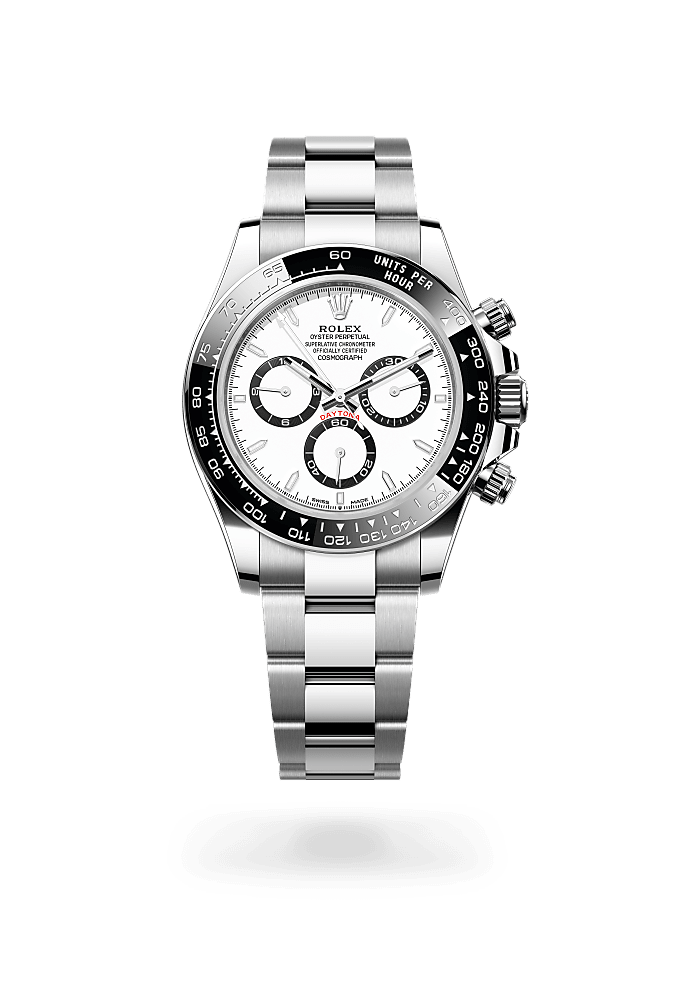
The Daytona 16520 is the Zenith-El-Primero-era Cosmograph Daytona, produced 1988 through 2000, that turned the Daytona from a discontinued curiosity into the most-collected modern Rolex sports chronograph. The reference uses a Rolex-modified Zenith El Primero base (Rolex caliber 4030); when Rolex introduced the in-house caliber 4130 in 2000, the 16520 closed the book on Rolex's outsourced-movement era for the Daytona.
Released 1988 to replace the discontinued 6263/6265 manual-wind Daytona, the 16520 reintroduced the Cosmograph with an automatic caliber. Rolex re-engineered the El Primero (slowed to 28,800 vph from 36,000, date module removed entirely since the Daytona is not a date watch, Glucydur balance, Microstella regulating system, and a redesigned escape wheel + pallets) for nearly half the parts. Production ran roughly 12 years; dial variants are the collector ladder, with the "Patrizzi" tropical sub-dial (a brown-aging white-dial subregister due to a paint defect) and the "Floating Cosmograph" (early printing variant) the headline outliers.
Steel examples on Oyster bracelets dominate the market; the 16523 / 16528 (gold) and 16519 (white-gold) variants are a much thinner market.
Common things to check: dial originality (Patrizzi tropical dials are heavily counterfeited, verify provenance against a known reference image and look for the brown's gradient pattern, not just the color); bezel insert (replacements are common; original 16520 inserts have a specific font and engraving depth); pushers (Rolex pusher hardware is rebuilt at service, look at age-appropriate finish); bracelet (a 78360 end-link bracelet matches the era; later 93150 or 78690 link variants are correct only on later production); engraved-rehaut (the 16520 does NOT have engraved-rehaut, a presented example with one is wrong).
Steel 16520 examples in clean, full-set, honest condition have been one of the most durable five-year holders in the vintage Daytona market. Patrizzi-tropical examples and four-line-dial early examples carry substantial premiums (in some cases the premium exceeds the watch's full-set non-Patrizzi value). The current market favors examples with documented service history and original paperwork over visually pristine examples without; the trade rewards honesty here.
The Rolex-modified Zenith caliber 4030 is well-understood by Rolex service centers and by competent independents. Rolex's official service still supports the caliber; the cost is meaningful but the work is routine. The most common issue presenting on examples coming to market is a chronograph register reset that hasn't been calibrated, a clean reset on all three subdials is one of the easier checks a buyer can perform in hand.
Community + OSINT signals haven’t landed for this reference yet. We don’t publish a rating against zero signal — the number would mean nothing. Editorial body + caliber + market value still surface above; ratings appear once the signal corpus does.
The 16520 Zenith Daytona is a highly collected reference and an authentication challenge because modified movements and refinished dials are both common.
| Area | What to check | What is correct | Red flag |
|---|---|---|---|
| movement | Cal. 4030 vs. base El Primero identification | Rolex-spec Cal. 4030 runs at 28,800bph; Rolex replaced the El Primero lever escapement with its own; verify via watchmaker | Full El Primero spec at 36,000bph; original El Primero escapement parts present |
| dial | Register dial text and color matching | All three registers should match in color and finish; no fading differential between registers | Differential fading between registers suggesting one or more were repainted; text inconsistency between registers |
| dial | Tropical patina authenticity |
The 16520 Zenith Daytona has two major authentication concerns: movement caliber integrity (Rolex-spec Cal. 4030 versus the base El Primero) and dial originality (tropical dials are a high-premium variant that attracts artificial aging).
| True tropical patina shows radial uniformity and consistent oxidation pattern across the entire dial surface |
| Patina concentrated at specific points; artificially darkened areas; color that shifts abruptly at register edges |
| case | Oyster case lug taper and finish | Straight lugs with characteristic Daytona taper; brushed top surfaces with polished flanks | Over-polished lugs reducing the original taper geometry; sharp corners softened by repeated polishing |
| caseback | Serial range and Zenith-era markings | 16520 produced 1988-2000; serials run approximately R series through Y series; correct markings for the year | Serial outside the production window for this reference; mismatched serial to dial/case generation |