Live pricing is coming soon. Get notified when it is available for this reference.
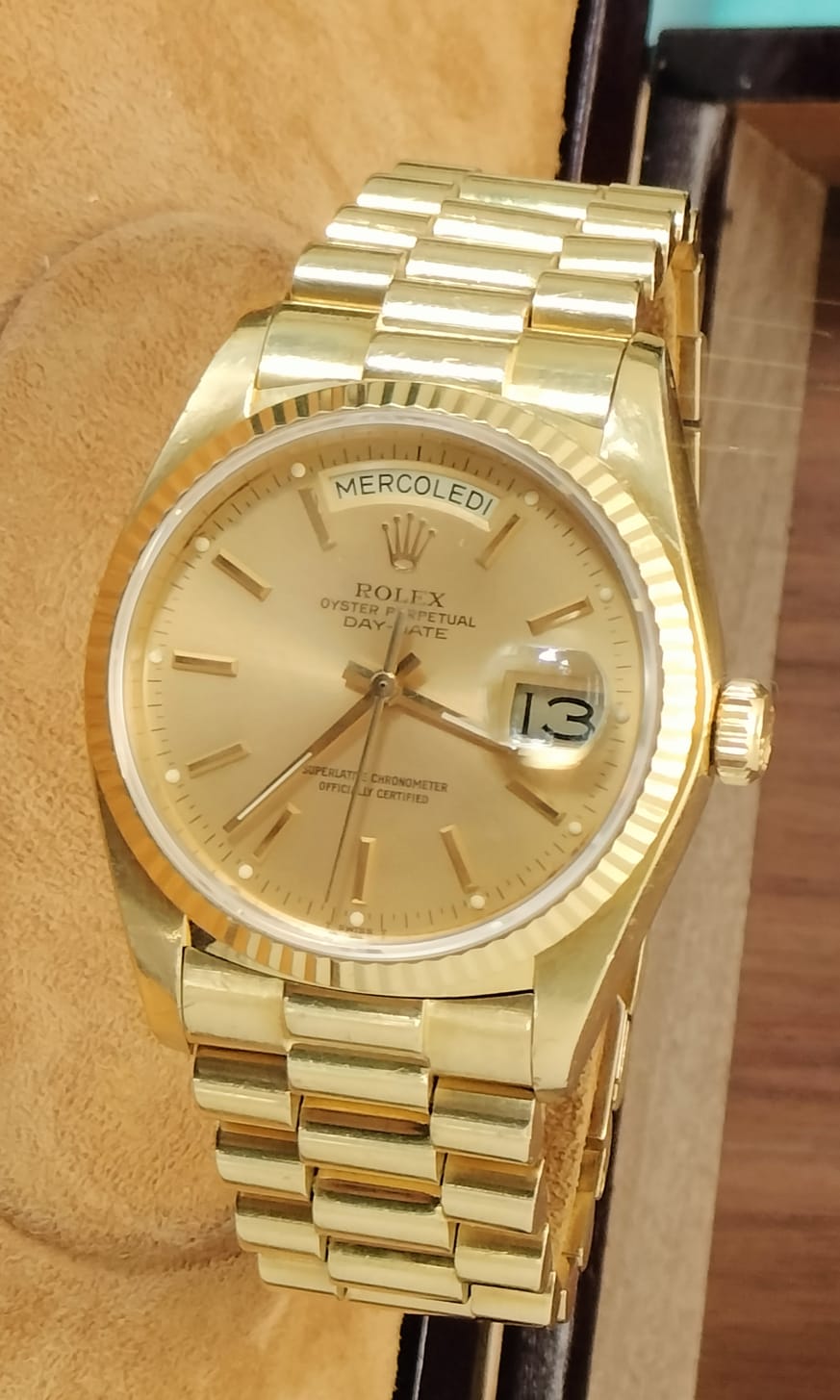
The Day-Date 1803 is the definitive vintage Day-Date, a 36mm yellow gold reference produced through the 1960s and 1970s that offered an extraordinary range of dial materials unavailable on any other production watch of the era. For collectors, it sits at the intersection of serious horology and decorative art, with exotic dials in wood, stone, turquoise, and onyx that were factory-fitted options, not aftermarket novelties.
Rolex produced the 1803 from 1960 to 1977, powered by the caliber 1556, a gold-rotor automatic with day and date complications. Early production used matte dials, which were gradually replaced by lacquered dials through the late 1960s and into the 1970s. The same reference accommodated an unusually wide range of factory dial materials, from conventional silver and champagne to semi-precious stone and marquetry wood.
The President bracelet was standard fitment throughout the run, though bracelet references evolved across the production span.
Dial originality is the central concern: exotic stone and wood dials have been swapped, refinished, or outright faked, so provenance and physical inspection matter. Check that matte dials have not been lacquered over (a common refinishing tell is overly uniform gloss and filled printing). Confirm the case retains its original proportions; over-polishing rounds the lugs and removes the crisp bevels that distinguish unpolished examples.
Verify that the President bracelet matches the era of the case, as later-production bracelets are frequently fitted to earlier cases. Service history documentation helps establish that the movement has not been replaced or significantly modified.
Exotic dial examples, particularly turquoise, onyx, meteorite, and marquetry wood, command substantial premiums over conventional silver or champagne dials, often multiples of the base price for the reference. Matte dial examples in original unrestored condition attract a collector premium over lacquered-dial pieces. Full-set examples with the original Rolex papers and hang tag are thin on the market and price accordingly.
Plain-dial, watch-only 1803s are relatively accessible for the category, but even those have trended upward as vintage Day-Date demand has broadened.
The caliber 1556 is a reliable movement that responds well to competent service, and parts availability from specialist suppliers is reasonable for a watch of this age. Service intervals of 7 to 10 years are appropriate. Budget for a thorough service by a watchmaker experienced with vintage Rolex movements; a recent service with documentation adds real value and removes uncertainty for the next buyer.
Community + OSINT signals haven’t landed for this reference yet. We don’t publish a rating against zero signal — the number would mean nothing. Editorial body + caliber + market value still surface above; ratings appear once the signal corpus does.
Dial originality is everything on vintage 1803 references; any dial that looks fresh on a 50-year-old case is a replacement.
| Area | What to check | What is correct | Red flag |
|---|---|---|---|
| dial | Dial aging consistency | Lacquer aging darker at lug areas and around applied indices; aging appropriate to stated production year | Uniformly fresh dial surface on a watch stated to be from the 1960s-70s; chemically treated aging is uniform, not organic |
| caseback | Cal. 1556 movement | Cal. 1556 or period-correct variant visible; movement bridges show aging consistent with a 50+ year old service history | Modern caliber architecture; service parts that are clearly newer than the case vintage |
| case | Case metal consistency with documented configuration | Precious metal case (yellow gold, white gold, or platinum) consistent across all case components |
| Color mismatch between bezel and case suggesting metal replacement; evidence of re-polishing removing original case lines |