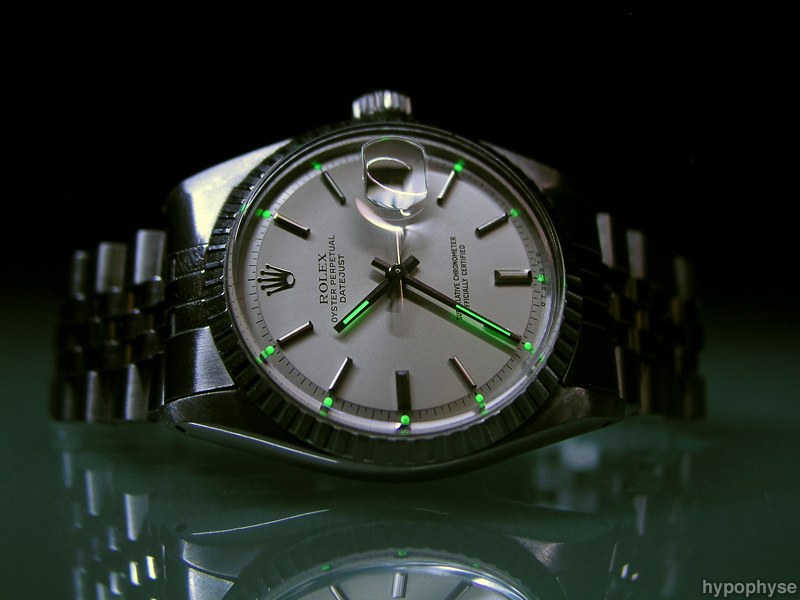
Live pricing is coming soon. Get notified when it is available for this reference.
The Datejust 1601 is a 36mm steel Datejust produced from 1960 to 1977, covering the period when Rolex was still dialing in what the reference would become. It ran the caliber 1570 and offered genuine variety: matte dials, sigma dials with gold-tipped indices, and the occasional tropical conversion that now commands serious money.
The 1601 succeeded the 1600 in 1960 and ran through 1977, spanning some of the most interesting dial evolution in Rolex's catalog. Early examples came with matte dials and applied indices; sigma dials, marked with the Greek letter sigma flanking the "Swiss Made" text, appeared through the mid-1960s into the 1970s to indicate solid gold index tips rather than gold-capped steel ones. The caliber 1570 is a 26-jewel movement with a 19,800 bph beat rate, refined from the 1560 series and considered one of the more reliable workhorses of the era.
Fluted and smooth bezels were both available in steel, and the lug width ran 19mm throughout the reference's production.
Check the dial carefully: matte dials were refinished heavily during service in the 1970s and 1980s, and many survivors have lost their original surface texture or gained incorrect gilt printing. Sigma dials are a specific desirability tier, so confirm the sigma characters flanking "Swiss Made" are present and sharp, not smudged or retouched. The case lugs on 1601s are frequently over-polished; prefer examples where the lug chamfers are still crisp and the case lines square.
Bracelets are often mismatched, as original 19mm jubilee bracelets are hard to find in good condition; a period-correct 1601 bracelet with matching end links adds meaningful value. Tropical dials on this reference do exist, but they attract fakes and aggressive refinishes, so prefer examples with auction or specialist provenance.
Sigma-dial examples carry a clear premium over standard matte or gloss-dial 1601s, particularly when the sigma characters are crisp and the dial is unrestored. Tropical examples, when genuine, trade well above standard references but the market for them is thin enough that pricing varies considerably by venue and buyer pool. Full-set examples with original box and papers are rare for this era and command outsized premiums; watch-only is the norm.
The 1601 overall has drifted upward with broader vintage Rolex demand but remains more accessible than the sport references from the same period.
The caliber 1570 is well-understood by independent watchmakers and parts availability is still reasonable. A service interval of 7 to 10 years is appropriate, and costs from a competent independent typically run $400 to $700 depending on parts needed. A documented recent service adds real value, particularly if the movement was not swapped or fitted with non-original components during prior work.
Community + OSINT signals haven’t landed for this reference yet. We don’t publish a rating against zero signal — the number would mean nothing. Editorial body + caliber + market value still surface above; ratings appear once the signal corpus does.
Vintage 1601 dial originality and appropriate aging are the primary value drivers; tropical dials require UV inspection to verify genuine aging.
| Area | What to check | What is correct | Red flag |
|---|---|---|---|
| dial | Dial aging and originality | Aging appropriate to stated production year; tropical aging (if present) shows non-uniform oxidation pattern consistent with organic aging | Chemically induced tropical aging is uniform; any dial that appears freshly lacquered on a 50+ year old case |
| dial | UV light inspection of tropical aging | Under UV light, genuine tropical aging shows variation in depth across the dial surface; the aging pattern is three-dimensional | Under UV light, chemically treated dials show flat, uniform response; artificial aging has no depth variation |
| caseback | Cal. 1570 movement | Cal. 1570 with period-correct service history; movement components consistent with vintage production |
| Modern movement in a vintage case; service components clearly newer than the case vintage |