The Chronometre a Resonance is the only wristwatch in production that uses acoustic resonance to synchronize two independent movements; secondary prices reflect the movement's singular technical achievement and tight supply.
Editorial estimate. Actual prices vary by condition, date, and box/papers status. Live pricing data is in development.
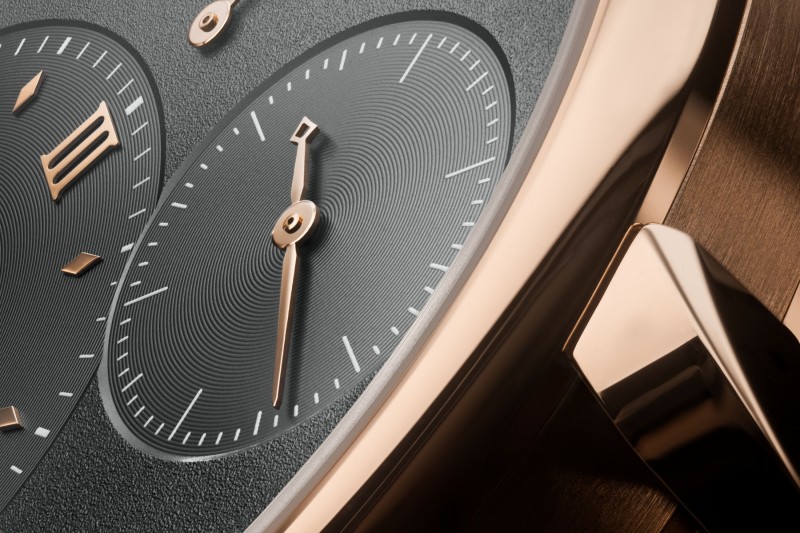
The Chronomètre à Résonance puts two fully independent movements inside a single 40mm rose gold case and lets physics do the rest. When the paired balance wheels synchronize through acoustic coupling in the shared baseplate, they regulate each other toward accuracy neither could sustain alone. This is not a complication added for spectacle; it is a working chronometric principle that Antide Janvier theorized in the 18th century and F.P. Journe spent years proving in production.
François-Paul Journe launched the Résonance in 1999, drawing directly on resonance theory first explored by Janvier and later Breguet. The principle holds that two oscillators sharing a medium will, over time, lock into phase opposition and stabilize each other against external disturbance. Journe's engineering challenge was building a baseplate rigid enough to transmit the acoustic coupling yet sensitive enough to let it happen at all.
The current Calibre 1520 in the 40mm rose gold case represents the mature production form of that research, refined across more than two decades. No other manufacture puts a working resonance movement in regular production.
The Résonance runs two complete gear trains, two mainsprings, and two regulation systems; servicing is substantially more involved than a conventional movement and should go only to FPJ-trained watchmakers or the manufacture itself. Setting the watch requires winding and synchronizing both movements, and owners who ignore the procedure can inadvertently break resonance lock, degrading the accuracy benefit the complication exists to provide. Dial versions have changed over the years, so verify that case, movement, and dial generation match before buying; mixed-generation examples occasionally surface on the secondary market.
Rose gold cases show wear on lugs and case-back edges with regular use, and the finishing on FPJ cases is distinctive enough that heavy polishing is immediately visible and reduces collector value. Prices on the secondary market have moved sharply upward since roughly 2021; any example offered well below current market retail warrants extra scrutiny on provenance and service history.
The 40mm rose gold Résonance trades at a meaningful premium to its original retail price on the secondary market, and demand has outpaced supply consistently since the broader FPJ market tightened around 2021. Full sets with original box, papers, and unpolished case command the strongest prices; dial condition is the single largest value driver after that. This reference is genuinely scarce in unworn or near-mint condition and is unlikely to soften unless FPJ increases production, which has not been their pattern.
Calibre 1520 service should be performed exclusively by F.P. Journe directly or by a watchmaker with documented FPJ training and access to manufacture parts. The resonance mechanism requires careful re-synchronization after any disassembly, and the dual-train architecture means service costs and turnaround times are higher than for a comparable single-movement piece.
Community + OSINT signals haven’t landed for this reference yet. We don’t publish a rating against zero signal — the number would mean nothing. Editorial body + caliber + market value still surface above; ratings appear once the signal corpus does.
Two synchronized balance wheels mechanically coupled by a resonance spring; fakes cannot replicate this
| Area | What to check | What is correct | Red flag |
|---|---|---|---|
| dial | Two independent time-zone sub-dials | Two separate time zone displays, each independently settable; regulator-style layout with hours, minutes, and seconds on each side; "Resonance" engraved prominently; "F.P.Journe" and "Genève" in correct typeface | Only one functional time display; second sub-dial that does not track time independently; "Resonance" text missing or incorrectly rendered |
| movement | Dual balance resonance coupling | Two balance wheels visible through the dial or caseback; resonance spring coupling mechanism between them; both balances running; tilt gently and observe both wheels swinging; calibre 1499 signing | Only one balance wheel; no coupling spring between balances; one balance wheel stationary while the other runs |
The Resonance uses Cal. 1520, a twin-movement caliber where two independent escapements couple via air resonance to improve rate stability. The two balance wheels are visible through the caseback beating in anti-phase opposition. This architecture is unique to FPJ among production wristwatches and is effectively impossible to replicate convincingly.
Budget for a full service interval of approximately five to seven years under normal wearing conditions.
| caseback | Calibre and serial engraving | "Calibre 1499.3" (or current variant) engraved; movement fully decorated and signed "F.P.Journe"; Geneva Seal or Journe decoration standard applied | Incorrect calibre number; solid caseback on a display variant; movement visible but unsigned or undecorated |
| case | Case material and crown position | Tantalum, rose gold, platinum, or yellow gold per documented production; 40mm or 38mm diameter; crown at 12 (distinctive FPJ signature for Resonance) | Crown at 3 (not correct for Resonance); case material inconsistent with documented variants; incorrect proportions |
| 2020 to present (current generation) | Asymmetric dial layout with two time displays, one for local time and one for a second timezone. Each display is governed by its independent movement module. |
|