
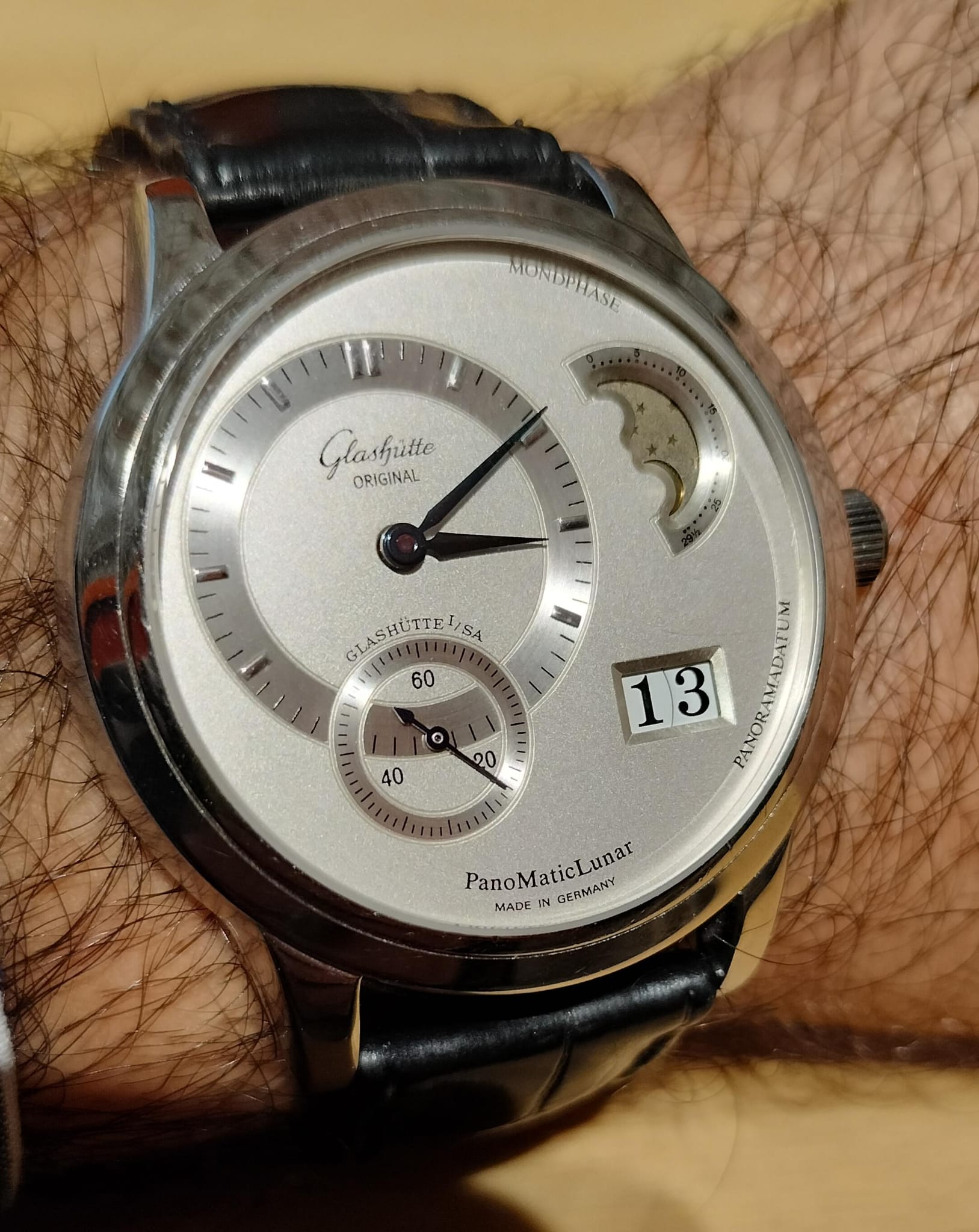
The Glashütte Original PanoMaticLunar | family history
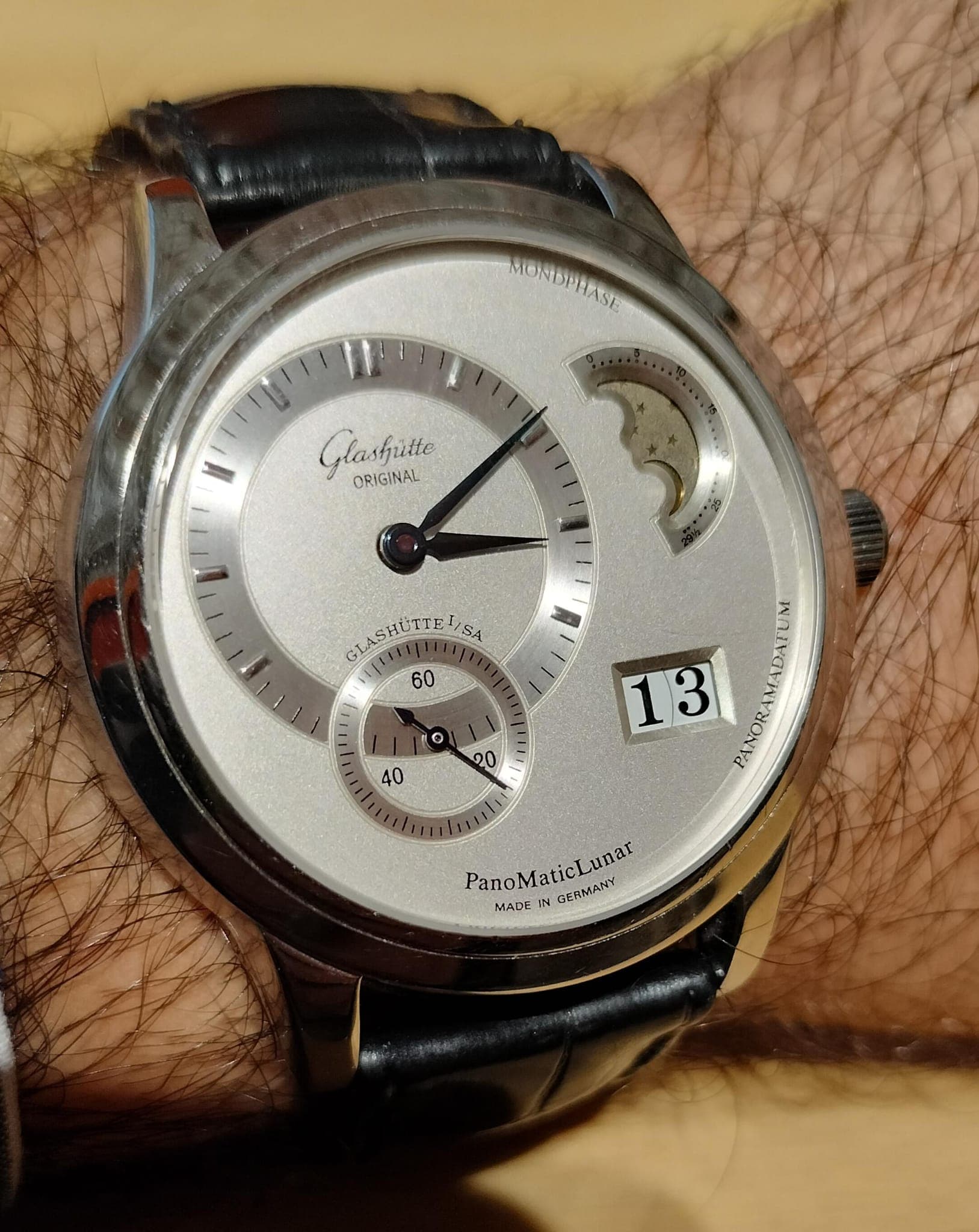
The PanoMaticLunar is Glashütte Original's most populated off-center dial: the main time display sits in the upper portion of the dial, the large panoramic date aperture at three, and the moonphase display above the small seconds at lower left. The bidirectional cal. 90-02 with its three-quarter plate and perlage finishing is visible through the caseback. The overall effect is a complication-rich dial that reads clearly because each subdial has clear territory. For buyers who want a moonphase watch with genuine movement credentials, the PanoMaticLunar is the argument for looking east of Geneva.
The automatic sibling to the PanoReserve: same off-center hour-and-minute display, but with the brand’s panorama big-date at three, a moonphase aperture above small seconds, and the bidirectional caliber 90-02 in place of the hand-wind 65-01. The Pano family’s most-traded reference.
2003–2015 · PanoMatic family launch
The PanoMaticLunar launched alongside the PanoReserve as part of GO's asymmetric-dial family. The automatic movement with its bidirectional rotor and Saxon three-quarter plate established the line's technical character. Early references are traded at modest premiums; the line has been in continuous production since launch.
No references from this era in the catalog yet.
2016–present · Current production
Current PanoMaticLunar production continues the three-subdial layout with ongoing refinements to the caliber and dial execution. The watch is available in steel and rose gold; the steel version is the accessible entry point and the better value argument. The moonphase display is accurate to one day in 122 years.
How to read this family
Two honest questions for any PanoMaticLunar buyer:
- PanoMaticLunar or Villeret Quantième Complet? Blancpain's Villeret QC and the PanoMaticLunar are different approaches to the same complication set: date, moonphase, and day-of-week in a dress watch context. The Villeret uses a symmetrical dial with a double-stepped case; the PanoMaticLunar uses an asymmetric dial in a round case. The movement finishing on both is serious. Price points are comparable in steel.
- How does the large panoramic date read on the wrist? The GO panoramic date is a large aperture showing the date digit prominently at three o'clock. It reads clearly and distinctively. It is not the traditional small date window; it occupies significant dial real estate and is one of the most immediate things you notice about the watch. For buyers who find the large date overwhelming, the Senator line offers more conventional date displays.
Related families: PanoReserve · PanoMaticInverse
References in this family
Which ref to buy
The PanoMaticLunar adds a moonphase complication to the PanoMatic platform -- the asymmetric dial places the moonphase at 9 o'clock and the small seconds at 7 o'clock. It is GO's most romantic complication and the dial composition is one of the more successful asymmetric layouts in German watchmaking.
- 1Open
PanoMaticLunar -- moonphase complication in GO's Pano format with asymmetric dial charm.
- The case for it:
- The moonphase display is beautifully executed -- the starfield background and precise lunar disc are among the more attractive moonphase implementations at this price tier. Cal. 90-02, automatic, three-quarter plate movement with Glashütte finishing.
- Consider instead if:
- Moonphase complications are romantic but functionally limited. Buyers prioritizing horological substance over visual poetry should consider the PanoReserve or Senator Perpetual.
Rankings last reviewed 2026-06-07. Editorial perspective only. Not financial advice.