

The H. Moser & Cie. Endeavour | family history
The Endeavour is the watch H. Moser & Cie. launched when the brand re-founded in 2005 under Melchior Moser and later the Meylan family. Every philosophy that makes Moser distinctive, including the fumé gradient dials made in-house at Moser's Schaffhausen atelier, the no-index dials with no logo on the dial of certain references, and the HMC movement family, originates here. Perpetual calendar, tourbillon, and minute repeater variants sit in this family. No other brand at Moser's price level integrates at the same depth.
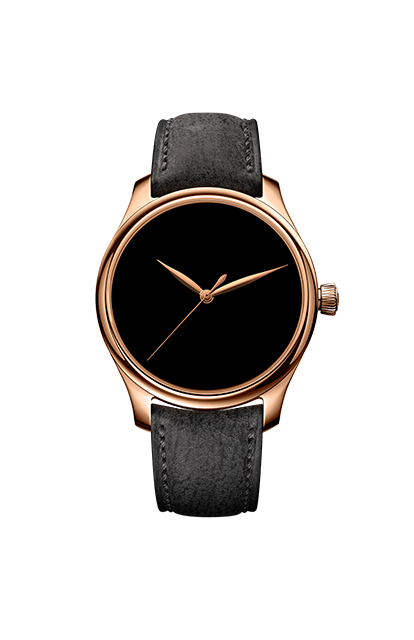
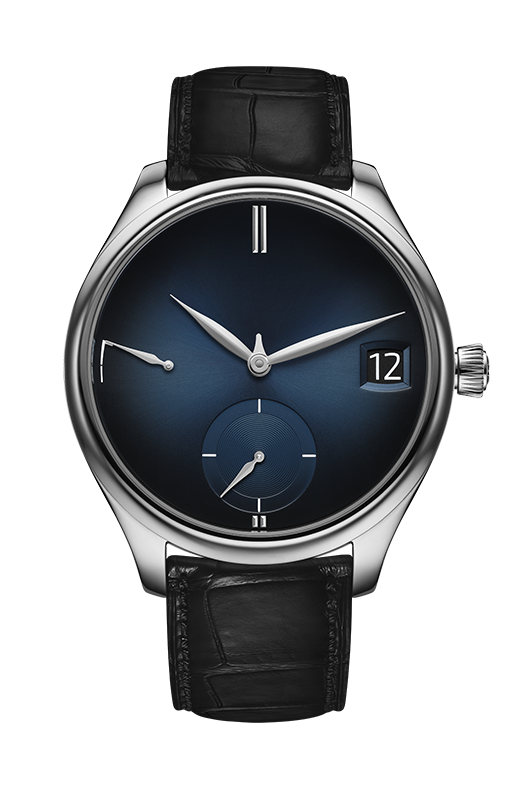
Moser’s dress-watch flagship: the line the brand’s "fumé" sunburst-to-edge dial vocabulary was developed for. The Centre Seconds Concept references strip the dial of indices, leaving only the hands; the Small Seconds adds a 6 o’clock register on the HMC 327.
2005-2012 · The founding generation
The original Endeavour launched as a time-only and small-seconds dress watch built around the HMC 100 automatic. The cases were 40-42mm white gold or red gold; steel was rare. The fumé dial, made at Moser's own Schaffhausen facility using vacuum deposition, distinguished the brand immediately from Swiss independent peers using bought-in dials. First-generation examples are uncommon on secondary markets and not yet tracked in the catalog.
No references from this era in the catalog yet.
2012-2018 · Perpetual calendar and complication expansion
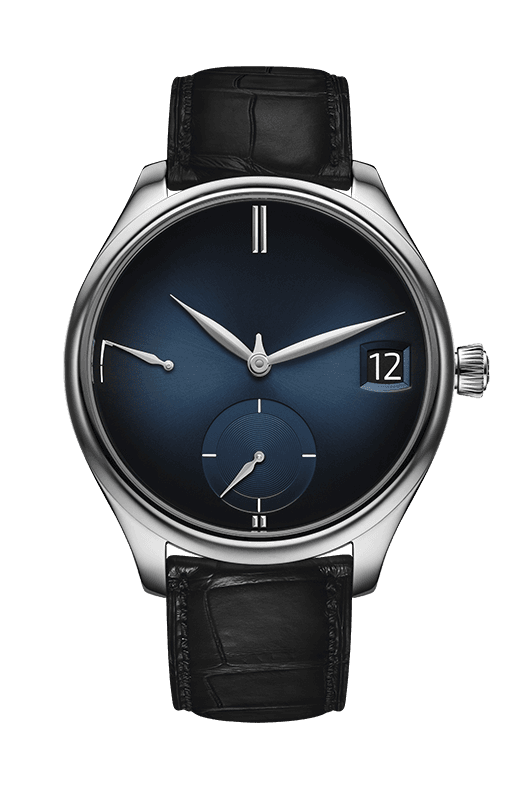
Moser introduced the Endeavour Perpetual Calendar with a highly simplified correction mechanism: all calendar functions set via the crown, no hidden pushers. The HMC 341 carried a 7-day power reserve via the double barrel. The Perpetual Moon followed, with a precision moonphase requiring correction once every 1027 years. These references established Moser as a serious complication house, not a boutique curiosity.
2018-present · Tourbillon Concept and the minimalist statement
The Concept variants strip the dial entirely: no indices, no text, just the fumé gradient and the hands. The Endeavour Tourbillon Concept carries a flying tourbillon with no cage spokes visible from the front. At this price level the watch argues directly against Jaeger-LeCoultre's Master Ultra Thin Tourbillon; the case finishing and movement execution compare favorably, and the fumé dial is singular.
No references from this era in the catalog yet.
How to read this family
Three honest questions for any Endeavour buyer:
- Fumé dial color: which one? Moser offers more fumé colorways than most buyers realize: salmon, green, blue, burgundy, purple, and the classic grey. Each is made to order and wait times vary. The grey and salmon are the most-traded on secondary; the green and burgundy are rarer and hold value better precisely because fewer exist.
- Steel or precious metal? Steel Endeavours are rarer than gold at Moser; the brand historically skewed toward precious metal. When a steel version surfaces it commands a premium. For buyers who want wearability over prestige signaling, steel is the right call and finding one takes patience.
- Time-only or complication? The time-only Endeavour makes the strongest dial statement: nothing competes with the fumé on a clean dial. But the Perpetual Calendar is exceptional value relative to what Patek and Lange charge for equivalent perpetual mechanics. The complication is not a consolation prize.
Related families: Moser Streamliner · Moser Pioneer · Calatrava
Sub-lines
- OpenThe hand-wound Endeavour: HMC 327 caliber, sub-seconds register at 6 o’clock, paired-barrel three-day reserve. Slimmer (9.3mm) and smaller (38.8mm) than the Centre Seconds, with the Moser fumé dial palette.
References in this family

Which ref to buy
H. Moser is the independent watchmaker most committed to fumé dials and most aggressive about stripping away everything non-essential. The Endeavour is their core collection -- cushion case, minimal dial, the fumé gradient as the visual signature. Moser makes their own movements and their fumé dials in-house.
- 1Open
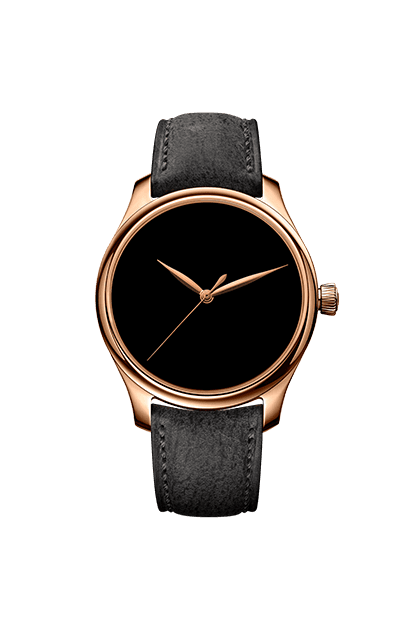
Endeavour Centre Seconds Concept -- the purist Moser; the fumé dial at its most extreme.
- The case for it:
- Cal. HMC 200, in-house automatic, 40mm, no indices, no numerals, no brand name on the dial -- just the fumé gradient and two hands. The Concept editions remove all text from the dial including the brand name. This is Moser making the strongest possible case for dial as pure craft object. The fumé gradient (typically deep green or blue to lighter at the center) is unlike anything a larger manufacture produces.
- Consider instead if:
- A watch with no indices or numerals requires the wearer to be able to tell time from hand position alone. Acceptable for most collectors; a genuine limitation for precise time-reading.
- 2Open
Endeavour Small Seconds -- the more conventional Endeavour with a small seconds sub-dial.
- The case for it:
- Cal. HMC 100, manually wound, 38mm, small seconds at 6 o'clock. The Endeavour Small Seconds is the historically paced Moser -- hand-wound, modest case size, clean dial. The fumé treatment is still present but with the small seconds adding a practical dimension.
- Consider instead if:
- Manual winding and the small case (38mm) make this specific. The Centre Seconds is the more modern statement.
- 3Open
Endeavour Perpetual Calendar -- the Moser complication; perpetual calendar with the fumé treatment.
- The case for it:
- In-house perpetual calendar mechanism, Moser's proprietary jumping calendar display, fumé dial. The Endeavour Perpetual is the technical summit of the collection -- the mechanism design is distinctive from established perpetual calendar architectures.
- Consider instead if:
- Perpetual calendar price at Moser's level approaches Patek territory. The value proposition is the movement design and the dial quality, not the brand premium. A legitimate buy for collectors who prioritize those factors.
Rankings last reviewed 2026-06-06. Editorial perspective only. Not financial advice.