
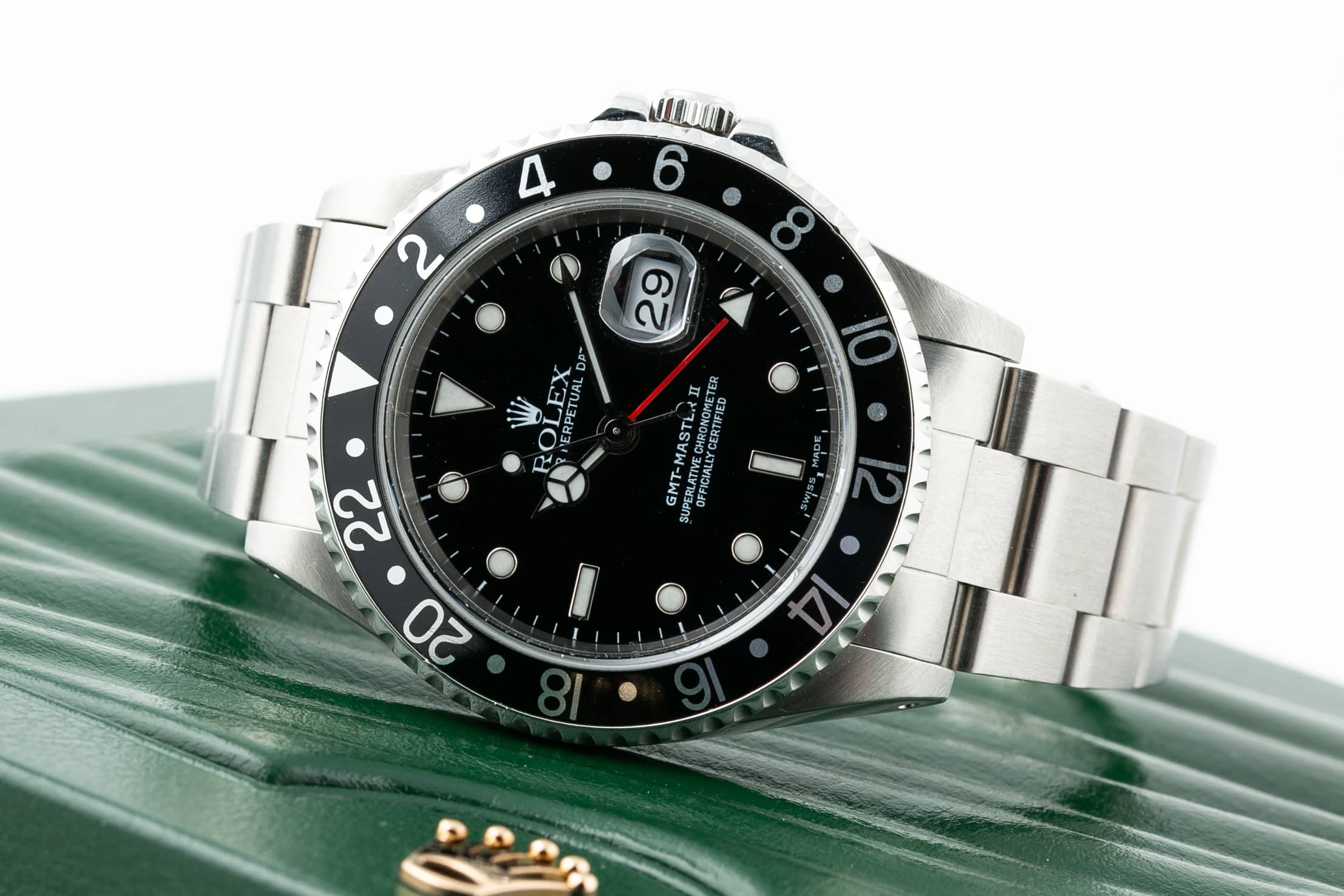
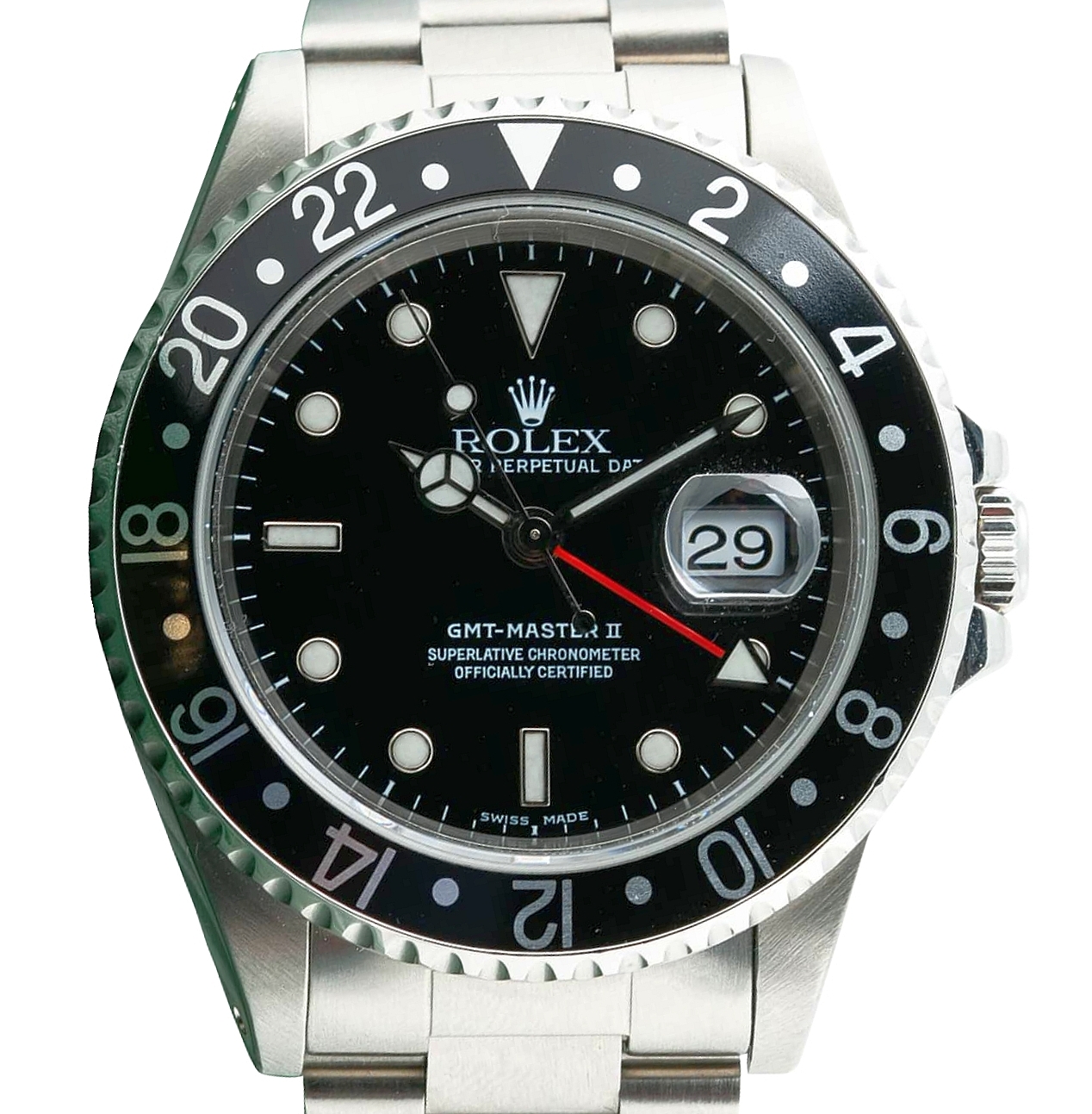


The Rolex GMT-Master | family history
Rolex developed the GMT-Master in 1955 at the request of Pan American Airways: international pilots needed to track home time alongside local time, and the rotating 24-hour bezel was the solution. Seven decades later the bezel-and-fourth-hand design is the most-copied dual-time-zone architecture in the industry. This walk frames each era and the references the catalog currently tracks.
Designed with Pan Am for transatlantic pilots. The two-tone bezel that started as a day/night marker became the most-imitated design language in tool watches.
1955–1980 · The GMT-Master (6542, 1675): single 24-hour hand
The original GMT-Master (ref. 6542, 1955–1959) had a bakelite bezel: pretty, fragile, and recalled after radioactive-radium-paint health concerns. Replaced by the 1675 (1959–1980), aluminium bezel, gilt-then-matte dial, caliber 1565/1575. The first-generation GMT-Master had a fixed 24-hour hand that moved in lockstep with the hour hand; to read a second time zone you rotated the bezel. Vintage market today (six-figure provenance plays for the 6542); not yet in the catalog.
No references from this era in the catalog yet.
1983–1989 · The GMT-Master II 16760, the “Fat Lady” Coke
Rolex introduced the GMT-Master II designation with the 16760 in 1983: caliber 3085, the first Rolex movement with an independently-jumping local hour hand (the breakthrough that defined GMT-Master II vs the original GMT-Master). Now you could change time zones without losing the home-zone reference. The case was beefier than the 1675, nicknamed 'Fat Lady.' Production ran briefly until the 16710 succeeded it. Not in the catalog.
No references from this era in the catalog yet.
1988–2007 · The 16710 and 16713, the slim aluminium-bezel era
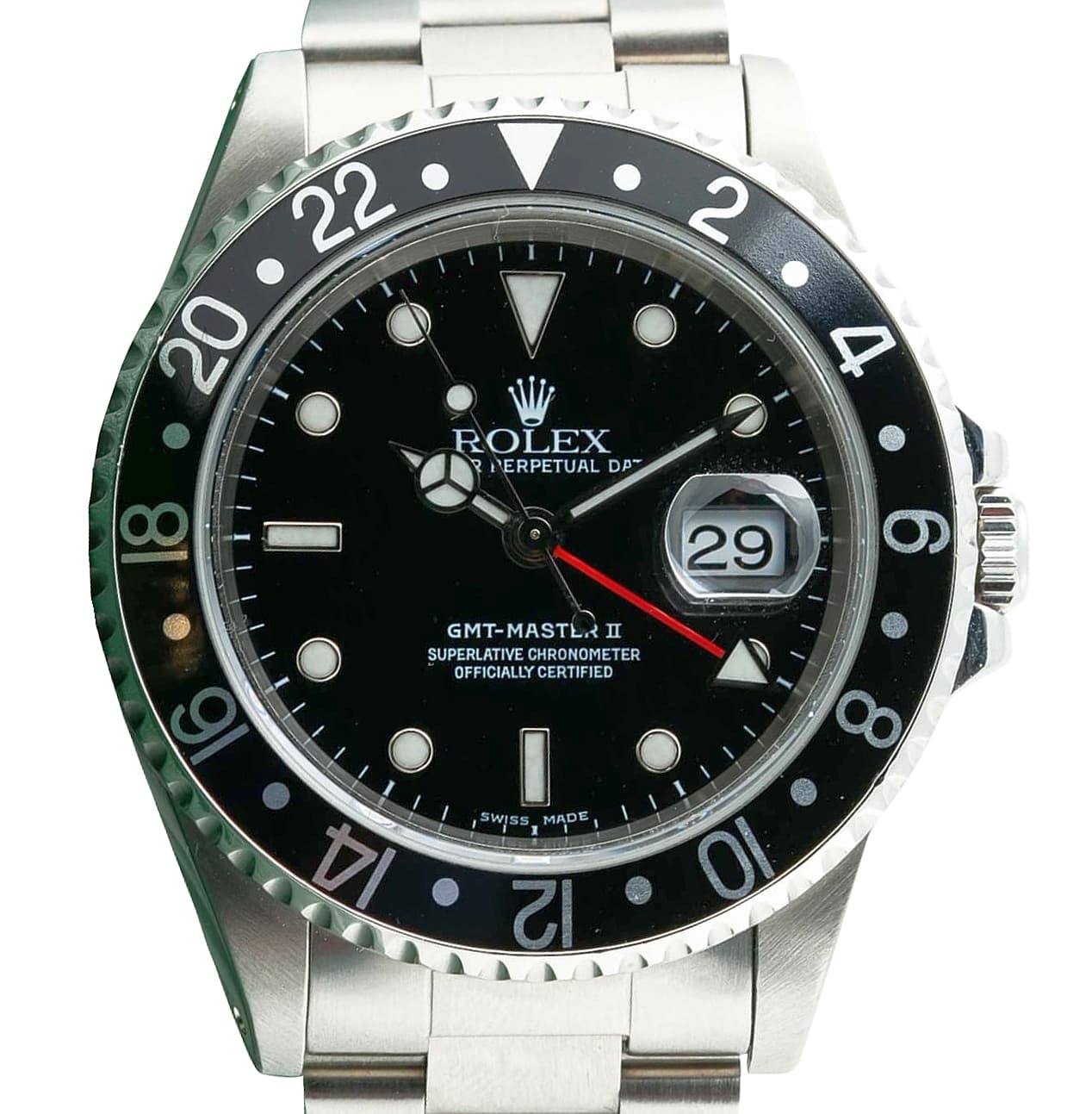
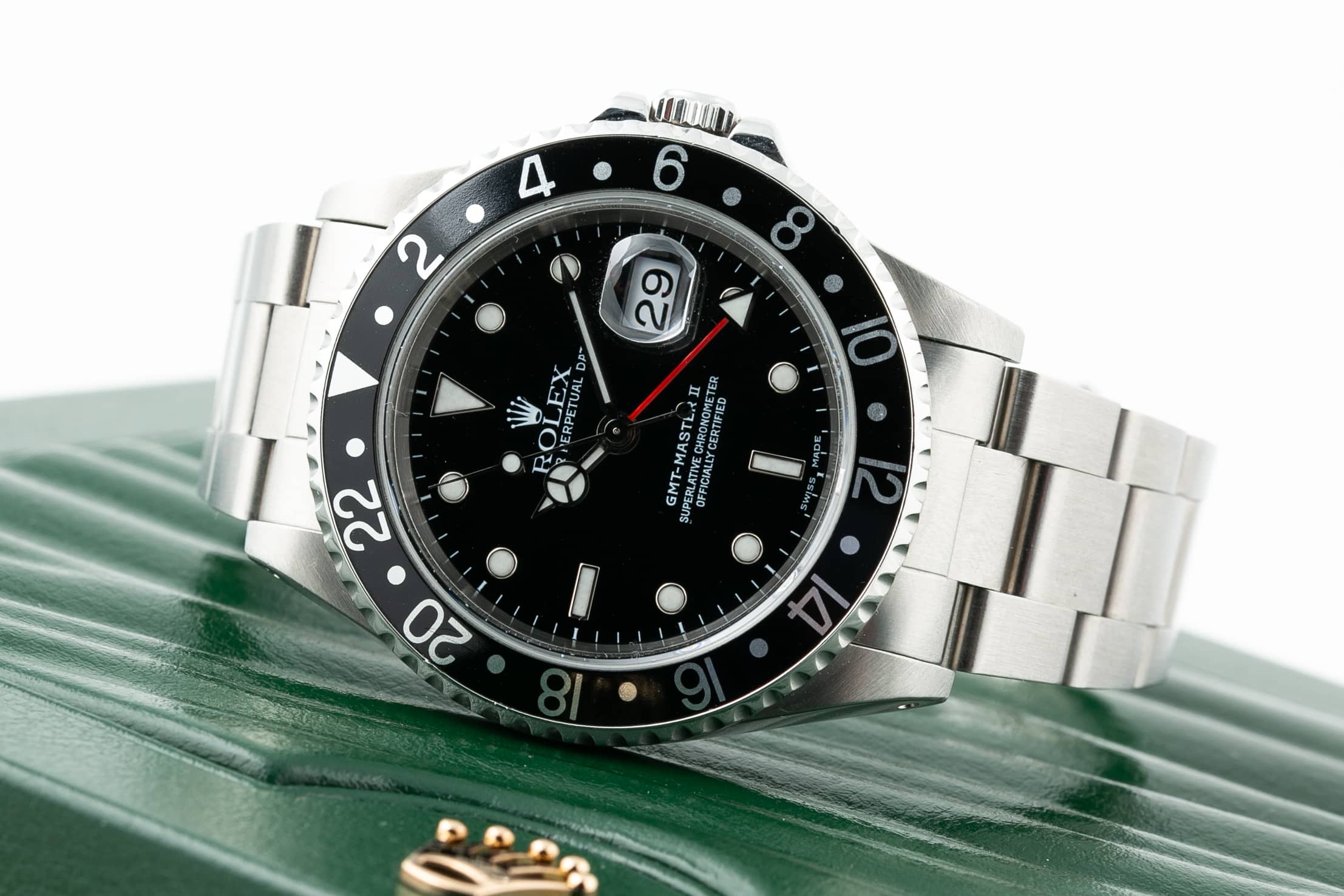
The 16710 (1989–2007) is the canonical aluminium-bezel GMT-Master II, slimmer than the 16760 'Fat Lady,' caliber 3185 (later 3186), case dimensions identical to the modern 40mm Submariner. Available in three bezel colors (Pepsi blue/red, Coke black/red, all-black). The 16713 (1988–2007) is the two-tone steel-and-gold 'Root Beer' variant. Twenty years of production, plentiful supply, and one of the most-honest pre-ceramic Rolex sport watches in the modern market.
- OpenLast GMT-Master II with an independently adjustable 24-hour hand before the current 126710; the "LNIB" market for this reference is strong.
- OpenTwo-tone root beer GMT-Master II at secondary prices well below equivalent steel references; collectors who want the GMT function without the sport-watch premium often land here.

2005–2018 · The 116710: ceramic bezel, supercase silhouette
Rolex moved the GMT-Master II to a Cerachrom (ceramic) bezel insert in 2005 with the 116710LN (all-black), the first ceramic-bezel Rolex sport watch. The Batman (116710BLNR, blue-and-black ceramic) followed in 2013, demonstrating Rolex's two-color ceramic capability. Caliber 3186. The supercase silhouette (wider lugs, larger crown guards) is shared with the 116610 Submariner era and reads larger than its 40mm spec. None in the catalog.
No references from this era in the catalog yet.
2018–present · The 126710: caliber 3285
The 126710BLRO (2018–present, 'Pepsi' two-color ceramic on steel) returned the Pepsi color combination to steel, previously white-gold-only. Caliber 3285: 70-hour power reserve, Chronergy escapement (the modern Rolex standard since 2018). Slimmer lugs than the 116710 supercase; case spec is still 40mm but it reads more accurately than the supercase generation. Jubilee bracelet has been the default; Oyster is available. Long retail waitlists; secondary market trades above MSRP.
- OpenFirst steel GMT-Master II with the Pepsi bezel since the original ref 1675; the return of the colorway drove significant waitlist demand at launch.

How to read this family
Three honest questions for any GMT-Master buyer:
- GMT-Master or GMT-Master II? The 'I' (1675 and earlier) has a fixed 24-hour hand; change time zones by rotating the bezel only. The 'II' (16760 onwards) has an independently-jumping local hour, the breakthrough functionality that defines the modern reference. For practical travel use, GMT-Master II is the right choice. The GMT-Master is vintage market.
- Aluminium or ceramic bezel? Aluminium (16710 and earlier) fades beautifully and is the vintage signature. Ceramic (116710 onwards) doesn't fade and doesn't scratch but lacks the patina story. The 16710 carries the vintage-aluminium premium; the 126710BLRO is the modern demand center.
- Pepsi, Batman, Coke, or Root Beer? Pepsi (blue/red) is the historical default and the most-collected. Batman (blue/black) is the modern-ceramic-only color and trades strongly. Coke (black/red) is the rarest of the modern ceramic options. Root Beer (brown/gold) is the two-tone version. Choose on aesthetics, not flip potential.
Related families: Submariner · Explorer · Sea-Dweller
Sub-lines
- OpenThe 1983-onward branch with the independently-adjustable hour hand; it lets the wearer set local time without disturbing the 24-hour reference hand. The technical-step that separates GMT-Master II from the original.
- OpenThe red-and-blue (Pepsi) Cerachrom-bezel branch of the modern GMT-Master II: the 126710BLRO in steel on Jubilee or Oyster (2018–present). The first two-color ceramic bezel Rolex shipped and the contemporary descendant of the 1955 6542 launch reference.
References in this family
- OpenLast GMT-Master II with an independently adjustable 24-hour hand before the current 126710; the "LNIB" market for this reference is strong.
- OpenTwo-tone root beer GMT-Master II at secondary prices well below equivalent steel references; collectors who want the GMT function without the sport-watch premium often land here.
- OpenFirst steel GMT-Master II with the Pepsi bezel since the original ref 1675; the return of the colorway drove significant waitlist demand at launch.
- Open
Which ref to buy
The GMT-Master II is the pilot/traveler's Rolex -- a genuine dual-timezone complication that wears as well on a creative-director as it does on a pilot. The Pepsi variant is the dominant modern reference.
- 1Open
The Pepsi Jubilee -- the most desirable current GMT configuration.
- The case for it:
- Blue-red Cerachrom bezel on a Jubilee bracelet, cal. 3285 with 70-hour power reserve, bidirectional GMT bezel. The Jubilee bracelet returns the ref to its roots (the original 6542 had a Jubilee). One of the hardest Rolex references to find at retail. Holds secondary value extremely well.
- Consider instead if:
- The premium is real and the wait is long. The Oystersteel/Oyster bracelet configuration (126710BLNR, Batman) is a perfectly valid alternative at slightly softer pricing.
- 2Open
The pre-ceramic GMT -- transitional reference with the strongest collector support in the pre-126710 era.
- The case for it:
- Cal. 3185, aluminum bezel insert (the last of them), 40mm case. The 16710 is the gateway to GMT collecting -- prices are rational relative to the modern 126710 and it wears identically in daily use. A good long-term alternative for buyers who cannot access the modern ref at retail.
- Consider instead if:
- Aluminum bezels fade over decades. An unrestored bezel is a visual choice -- some find the aging character desirable, others want uniformity.
- 3Open
"Coke" configuration in vintage steel -- the GMT for buyers who want the two-tone bezel history in an all-steel case.
- The case for it:
- The 16700 predates the date window cyclops on some variants. Good entry price for vintage GMT collecting. The black-red (Coke) bezel has a different visual personality than the later Pepsi.
- Consider instead if:
- Less liquid secondary market than the 16710. The 16710 is the more standardized buy.
- 4Open
Two-tone Rolesor "Root Beer" -- specific to buyers who want the yellow gold accent in a steel-dominant case.
- The case for it:
- The Root Beer combination (brown-gold bezel, Rolesor case/bracelet) is a distinct aesthetic that has no modern equivalent. Strong following among buyers who appreciate the two-tone look.
- Consider instead if:
- Two-tone has a narrower secondary market than all-steel. Specific clientele only.
Rankings last reviewed 2026-06-06. Editorial perspective only. Not financial advice.