


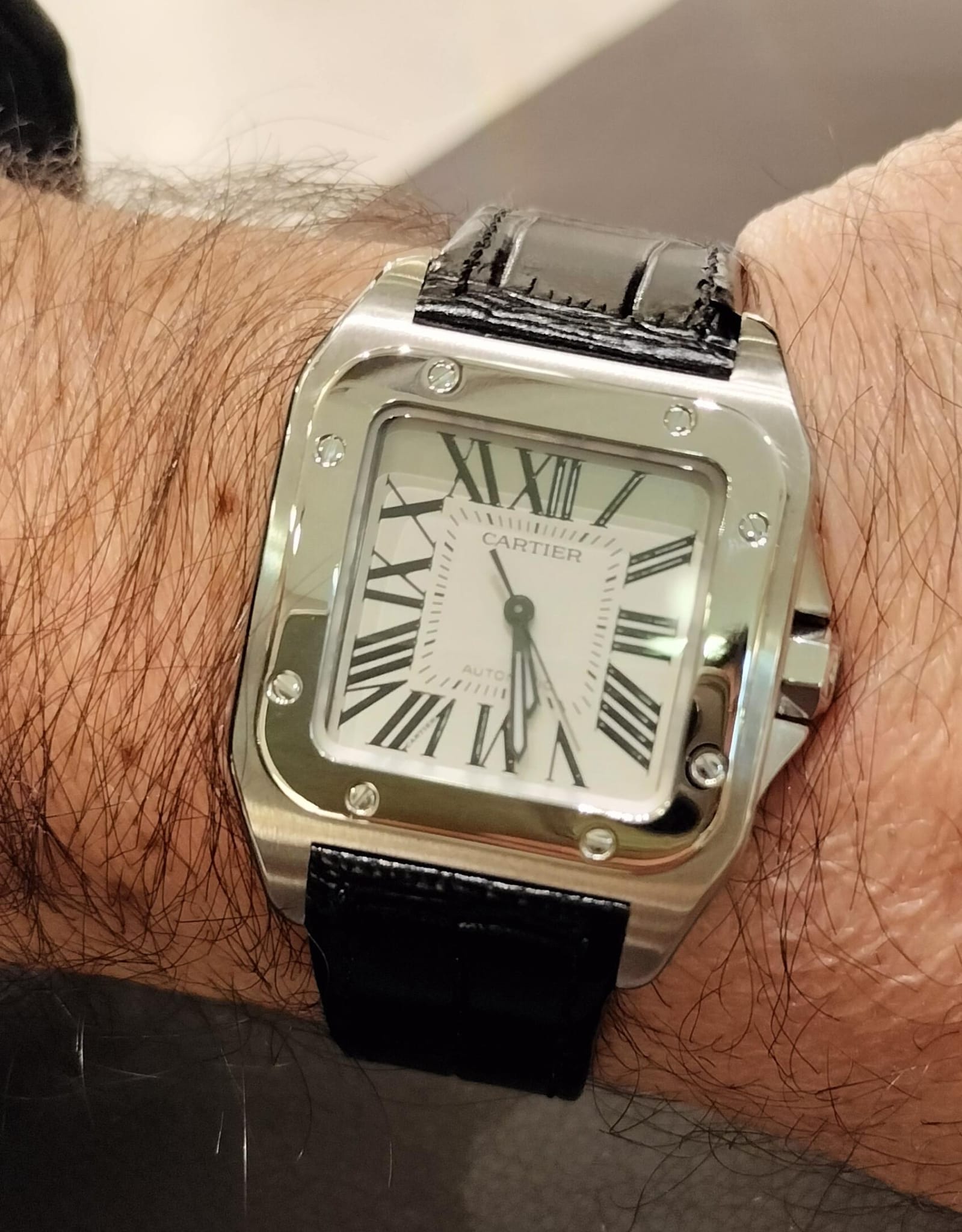
The Cartier Santos | family history
Alberto Santos-Dumont was a Brazilian aviation pioneer who complained to his friend Louis Cartier that he could not check his pocket watch while keeping both hands on the controls of his aircraft. Cartier made him a wristwatch with an exposed square bezel and screwed steel bezel frame in 1904. This was not the first wristwatch ever made, but it was among the first commercially significant men's wristwatches and almost certainly the most photographed, because Santos-Dumont wore it publicly at every demonstration flight. The Santos is 120 years old and the current-production Santos de Cartier is genuinely excellent: well-proportioned, the QuickSwitch bracelet-to-strap system is the best quick-change mechanism in the industry, and the steel versions are available at retail without allocation games.
Made for aviator Alberto Santos-Dumont in 1904, widely cited as the first purpose-built wristwatch. Defined by the squared bezel and exposed screws.
1904–1978 · The origin and the long hiatus
Louis Cartier made the first Santos for personal use in 1904; commercial sale began around 1911. The square case, exposed screws on the bezel, and Roman dial established the architecture immediately. The watch sold well through the 1910s–1930s and then largely disappeared from Cartier's commercial focus until the 1970s redesign. Vintage examples from this era are in fine-watch auction territory and distinguished by case condition and caliber authenticity; not in the catalog.
No references from this era in the catalog yet.
1978–2004 · The modern Santos relaunch and the Santos 100
Cartier relaunched the Santos in 1978 with updated proportions and quartz movements initially, then automatic. Through the 1980s and 1990s the Santos was Cartier's flagship men's sports watch alongside the Pasha. The Santos 100 (oversized 51mm variant, 2004) was the maximalist version of the design; it has aged poorly and trades weakly. The pre-2018 Santos generations are available cheaply on the secondary market; caliber quality varies widely between the quartz and early automatic examples.
No references from this era in the catalog yet.
2018–present · The Santos de Cartier: QuickSwitch and the ADLC options
Cartier redesigned the Santos in 2018 as the 'Santos de Cartier,' adding the QuickSwitch bracelet-to-strap interchangeable system (tool-free, seconds-to-swap), ADLC (carbon-like) coating options on the bezel screws and bracelet links for the bicolor variants, and the caliber 1847 MC automatic. 35mm medium and 40mm large sizing. The QuickSwitch mechanism is the best rapid-change system in the industry at any price point; it works reliably and keeps the wrist feeling right across different strap types. The steel medium (WSSA0029) is the canonical modern Santos.

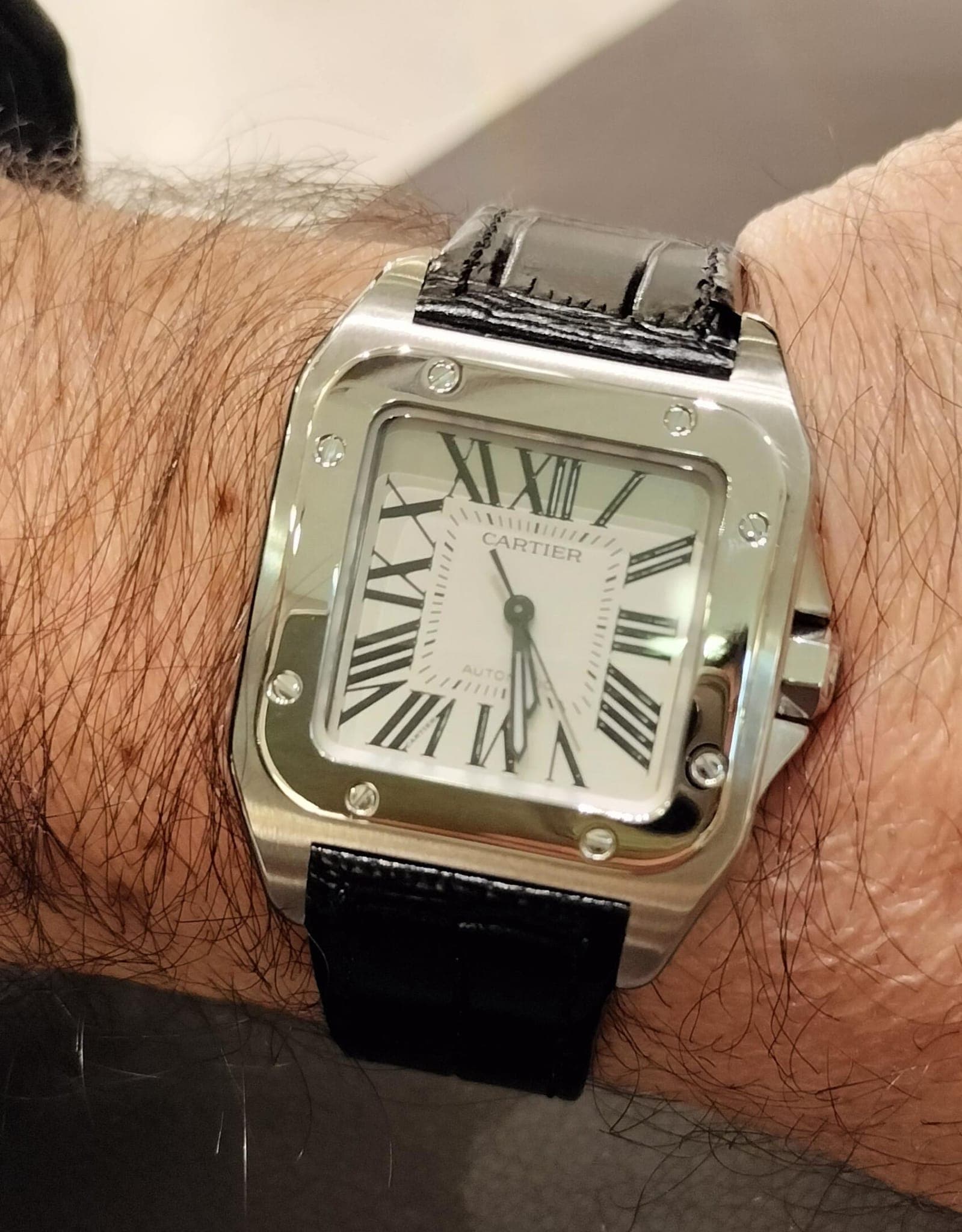
2018–present · The Santos-Dumont XL: the dress variant
The Santos-Dumont XL (WSSA0032) is 47mm long but only 38mm wide, slim (8.1mm tall), manually wound on caliber 1611 MC with a 72-hour reserve. It is the dress Santos: no date, leather strap only, no QuickSwitch, a thinner and more period-adjacent expression of the original. The proportions are longer than the Santos de Cartier and read more Baignoire-adjacent on the wrist. For buyers who want the Santos story in a thinner package without the sport-dress ambiguity of the regular Santos de Cartier, the XL is the answer.

2019–present · The Santos Chronograph
The Santos Chronograph (WSSA0017, 2019) is 43.3mm, 12.4mm tall, and runs caliber 1904-CH MC: an integrated automatic column-wheel chronograph with vertical clutch. It is the most complicated Santos in the current catalog and the best technical execution of the Santos case. The QuickSwitch mechanism is present; it takes the integrated-bracelet look of the regular Santos and adds chronograph functionality without obvious layout compromises.
How to read this family
Three honest questions for any Santos buyer:
- Medium (35mm) or large (40mm)? The medium Santos de Cartier sits at 35mm width, 9.4mm tall; the large is 40mm and slightly taller. For men on the smaller-wrist side (under 17.5cm), the medium wears more proportionally correct and references the 1904 original more accurately. The large wears as a contemporary sport-dress watch. Both use the QuickSwitch mechanism. Try both if you can; the size difference matters more than the millimeters suggest because of the square case geometry.
- Steel or bicolor? The steel Santos uses a steel bracelet with ADLC-coated black screws and links on the bicolor variant, or all-steel on the standard. The 'bicolor' ADLC looks are Cartier's version of a two-tone: steel case, black-coated accents. The classic all-steel version reads cleaner and ages more predictably. Bicolor is a distinct aesthetic choice, not a premium tier. Buy what you will wear.
- Santos de Cartier or Santos-Dumont XL? These are genuinely different watches. The Santos de Cartier is the sport-dress daily wearer: 35–40mm, QuickSwitch, automatic, date. The Santos-Dumont XL is the thin dress watch: 47x38mm, manual-wind, no date, leather only. If you want one watch that covers work through weekend, Santos de Cartier. If you want a dress watch for formal occasions that tells the Santos origin story, Santos-Dumont XL.
Related families: Tank · Ronde de Cartier
Sub-lines
- OpenThe contemporary Santos line, redesigned in 2018 with the QuickSwitch bracelet/strap interchange and SmartLink sizing. The medium-size 35mm steel reference is the modern archetype.
- OpenThe current-production Santos in medium (35.1mm) size, the variant that re-launched the line in 2018 with the QuickSwitch interchangeable bracelet and strap system. Sits between the smaller 100 and the full 39.8mm large, making it the preferred size for wrists that find the large too dressy.
References in this family
Which ref to buy
The Santos is historically significant as the first purpose-designed wristwatch for a man (Alberto Santos-Dumont, 1904). The screwed bezel, square case, and Roman numeral chapter ring are unchanged. The 2018 redesign added the QuickSwitch interchangeable strap system and improved bracelet quality significantly.
- 1Open
Santos Medium Steel -- the correct specification for most wrists.
- The case for it:
- The medium (35.1mm x 41.9mm) is the better-proportioned Santos. Cal. 1847 MC, ADLC-coated screws, QuickSwitch strap/bracelet system. The 2018 redesign fixed the bracelet play that plagued earlier production. Cartier steel bracelet fit and finish is notably better post-2018. Extremely wearable -- the square case wears closer to 38mm on the wrist than the lug-to-lug suggests.
- Consider instead if:
- Steel Santos pricing is near or above retail at auction. The resale market is active but not deep. Budget for a long retail wait or a modest secondary premium.
- 2Open
Santos Large 40mm Steel -- the larger configuration, better for wider wrists.
- The case for it:
- Same architecture as the medium in a 39.8mm x 47.5mm case. Strong visual presence. The correct choice if the medium reads small on your wrist.
- Consider instead if:
- The medium is the historically proportionate Santos. The large is a contemporary interpretation -- visually bold but not the purist configuration.
- 3Open
Santos-Dumont XL -- the thin, dress-oriented Santos without the sport bracelet.
- The case for it:
- The Santos-Dumont is the dress variant -- thinner case, leather strap only, manual-wind caliber. The correct Santos for formal wear. The XL (43.5mm x 31.4mm) is actually a slender rectangular watch despite the XL designation.
- Consider instead if:
- The Santos-Dumont is a different watch from the standard Santos -- leather only, no bracelet option, thinner case. Make sure you want the dress orientation before buying.
- 4Open
Santos Chronograph -- adds timing function in the Santos square case.
- The case for it:
- The Santos with chronograph registers fills the case well -- the sub-dials suit the square proportions. The correct Santos for buyers who specifically need a chronograph.
- Consider instead if:
- A square-case chronograph is a specific aesthetic commitment. For most buyers the clean three-hand Santos medium is the more versatile choice.
Rankings last reviewed 2026-06-06. Editorial perspective only. Not financial advice.